
Before we begin, we would like to remind our followers that they can support the Rasputin Archive on Buy Me a Coffee. We work hard to keep all of our content freely accessible, and every donation helps us acquire research materials for this project. Supporters will receive access to the Rasputin Archive Virtual Library, which includes rare and valuable works such as the four-volume series The Last Tsar by S.S. Oldenburg, My Father by Maria Rasputina, and Rasputin’s own book My Pilgrimage to Jerusalem. The library also features English translations of rare Russian books that are not accessible anywhere else.
Tsarevich Alexei Nikolaevich, the son of Tsar Nicholas II, suffered from a disease called hemophilia. Hemophilia is an inherited disorder in which the blood does not clot properly, a life-threatening condition that can lead to internal bleeding, organ damage, and death, especially before the development of modern treatments.1 The Tsarevich’s illness was kept a state secret to avoid public outcry and potential harm to the heir. It is a known fact that even certain nobles were trying to harm the Tsarevich, which meant that only a few trusted people could know about his condition.2 Rasputin first became involved in the care of Tsarevich Alexei around 1906, miraculously helping to heal his condition and often leaving doctors perplexed on how he did it. This led several of Rasputin’s supporters to cite his apparent gift of healing3 as proof of his holiness. After all, it is quite a compelling argument for a semi-literate peasant from Siberia to effectively heal and save the Tsarevich’s life several times when the best doctors in the Empire couldn’t. Conversely, Rasputin’s detractors within the Church4 have allied themselves with secular historians to explain away Rasputin’s gift of healing, stating that it was fundamentally nothing other than ignorant luck.
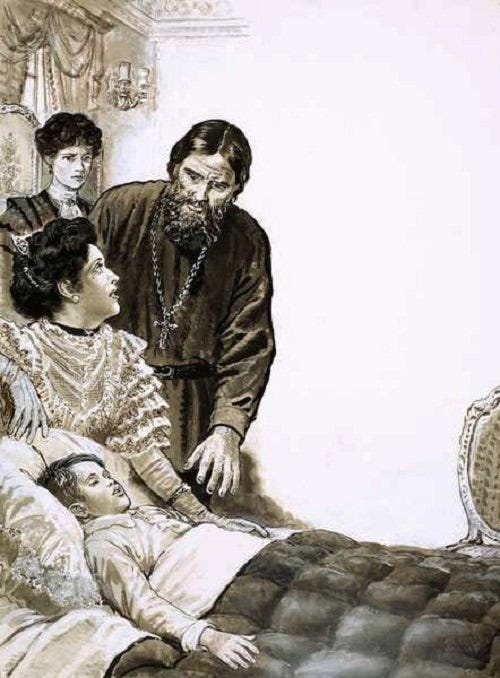
The idea that Grigory Rasputin was healing Tsarevich Alexei by preventing the use of aspirin5 for his condition has been repeatedly asserted, to the point that it has become the prevailing theory. The theory is as follows:
Aspirin, being a blood thinner, would most definitely be a terrible prescription for someone suffering from hemophilia as it promotes bleeding. This was not known to doctors at the time, who decided to prescribe it to Alexei for its pain-relieving properties. Rasputin, however, being distrustful of all medicine, told the doctors to leave Alexei alone, indirectly stopping the prescription of aspirin and improving Alexei’s condition. Hence, it is not due to miraculous powers of healing that Alexei was healed; Rasputin was simply ignorant and got lucky by unknowingly stopping the prescription of a harmful drug.
This theory has been popularized by respected historians like Hélène Carrère d’Encausse,6 Helen Rappaport7 and even top Rasputin biographer Sergei Fomin.8 Consequently, popular commentators have repeated the “aspirin theory” ad nauseam, baselessly asserting it as fact. When asked about the origin of such a theory, these individuals will cite “conventional wisdom,” noting the unclear primary source trail behind it. This idea, however, faces several issues that make it fundamentally a weak theory.
For starters, even if one were to concede that the healing of Alexei occurred due to the cessation of aspirin, this would not be incompatible with Rasputin’s gift of healing. In fact, it could be argued that Rasputin possessed both clairvoyance and healing, which allowed him to perceive that something was wrong in the Tsarevich’s prescription and put a stop to it.9
However, this concession does not need to be made. When tracing the origins of the “aspirin theory,” one is always led back to one name: Pierre Gilliard. Pierre Gilliard was the Romanov children’s French language tutor, and his memoirs were compiled in a book titled Thirteen Years at the Russian Court. Allegedly, the idea that Alexei was being prescribed aspirin originated with him,10 yet no such quote appears in his memoirs. One is left wondering about this idea that many seem to believe in, yet few can identify the origin of.
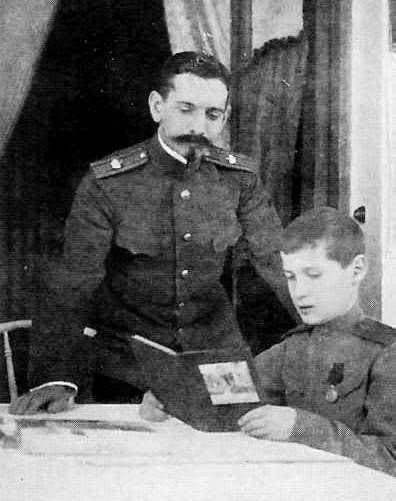
Finally, we have come to the conclusion that the theory did not originate with Gilliard himself, but with his biographer Daniel Girardin.11 Girardin wrote Le Précepteur des Romanov: Le destin russe de Pierre Gilliard, where a quote from Chapter IV outlines perfectly the creation of this theory. Girardin writes, “It's highly likely that Alexei was taking aspirin, a drug with a pronounced therapeutic effect. This versatile Swiss remedy, introduced in 1858, also acts as a painkiller. However, it wasn't yet known that aspirin thins the blood and is contraindicated for hemophilia. From the very beginning, Rasputin insisted on stopping all medications. It may have had a positive effect on the course of the disease for reasons far removed from mysticism. Stopping aspirin led to an improvement in Alexei's condition.”
That is essentially the basis of the theory, historical speculation by the French tutor’s biographer. We believe that through this work, the “aspirin theory” entered Rasputin historiography. This may be why it is so hard, perhaps impossible, to find any reference to aspirin in books about Rasputin before 2005. Yet there is one, and this may be the true origin of the theory: Diarmuid Jeffreys’ Aspirin: The Remarkable Story of a Wonder Drug, published in 2004.12 Jeffreys writes that “It’s very likely that to ease the pain the imperial doctors prescribed [aspirin].”13 Once again, the language used is one of likelihood and speculation, not certainty.
It is not our intent to attribute malice to the aforementioned authors. However, there is a problem with promoting a theory that is based on no primary evidence whatsoever as fact. As explained by the reputable Romanov biographer George Hawkins,14 “One thing which could be noted - over the last few years I have seen it alleged that Rasputin got the Doctors to stop giving Tsesarevich Alexei aspirin. However, I have never come across a primary sourced piece of evidence that shows he was ever administered this. It is just asserted, and no sources are ever cited. We do know from diaries and letters though that he was administered morphine for pain now and then.”15
Helen Rappaport16 kindly responded to our inquiry about the “aspirin theory” which she posits in The Romanov Sisters,17 confirming our interpretation once again.
Dear Alex
Thank you for your email. In my book I say that Rasputin did not approve of Alexey being given aspirin, the implication being to warn against it being administered. It is possible that he said this in response to finding out that they had indeed given him aspirin. But I do not know of any source confirming this one way or the other. Nicholas and Alexandra, as we know, were highly resistant to any intervention with drugs, such as morphine, which had only been given to Alexey on very rare occasions when his pain was severe. But, as George says, there is no hard evidence of aspirin being actually given to Alexey. But perhaps the possibility had been discussed with Rasputin by N&A??18
To be clear, we do not oppose such a theory in principle, as it is entirely compatible with Rasputin’s gift of clairvoyance. In fact, it would not be the first time that Rasputin stopped the administration of harmful drugs to the Tsarevich.19 Rather, we find the theory unconvincing given the remarkable lack of evidence. As it stands, there is no primary-source evidence available to demonstrate that Alexei was ever administered aspirin. If any were to appear, we would gladly welcome it, but as of now it is still historical speculation.
What we strongly oppose, however, is the trivialization of Rasputin’s gifts by reducing them to mere chance.
So, is there any proof that Rasputin healed Alexei through miraculous means?
The truth of the matter is that no doctor in the Russian Empire knew how to treat Alexei for his disease, yet Rasputin, through his prayers, managed to save his life multiple times. The Tsarina was convinced that Rasputin possessed a miraculous gift of healing which he faithfully used to save her son.20
There may be no better example of this than the famous Spala incident. In October, 1912, Alexei suffered an accident which left him bed-ridden and in need of surgery, which was virtually impossible due to his hemophiliac condition. Doctors did not know what to do and his condition continued to deteriorate, his temperature rising by the hour. Alexei, sure that he would die, asked the Tsarina, “When I am dead, it will not hurt anymore, will it, Mama?”21 Then, on October 22, Grigory Rasputin sent a telegram to the Tsarina, saying: “God has seen your tears and heard your prayers. Grieve no more. Your son will live.”22 The next day, the Tsarevich’s temperature fell and his condition continued improving until he was completely healthy again.
Grand Duchess Olga Alexandrovna, the sister of Nicholas II, would testify the following: “An hour later, my nephew was out of danger. Later that year, I met Professor Fedorov, who told me that the healing was completely inexplicable from a medical standpoint. Rasputin definitely possessed the gift of healing. There is no doubt about it. I saw these results with my own eyes, more than once. I also know that the most renowned doctors of the time were forced to admit it.”23
This stands as one of the most compelling examples explored in our articles and forms a strong argument for Grigory Rasputin’s gift of healing. This question should be considered on the basis of events, experiences, and observations recorded by holy people and contemporaries, rather than on historical speculation developed a century later and lacking primary-source evidence.
“Tsarevich Alexey would have been dead within a very few years if Rasputin's genius had been lacking.”24
Dr. Elizabeth Judas
Cleveland Clinic, “Hemophilia,” Cleveland Clinic, last modified October 1, 2025, https://my.clevelandclinic.org/health/diseases/14083-hemophilia
Elizabeth Judas, Rasputin: Neither Devil Nor Saint, 99–100.
GARF, f. 1467, op. 1, unit of storage 949, sheet 5.
Anna Vyrubova, Memories of the Russian Court (1923), 121.
Lili Dehn, Podlinnaia Tsaritsa (The Real Tsaritsa), 64.
Igor Vasilievich Evsin, “Особые духовные дары Григория Распутина,” Русская Народная Линия (Ruskline.ru), March 25, 2013, https://ruskline.ru/analitika/2013/03/26/osobye_duhovnye_dary_grigoriya_rasputina.
An example of this is the UOJ’s article on Rasputin which we have extensively refuted.
M. W. Davis, “Was Rasputin a Saint?” Union of Orthodox Journalists, January 6, 2026, https://uoj.news/history-and-culture/86000-was-rasputin-a-saint.
Aspirin is the common name for acetylsalicylic acid (ASA), a nonsteroidal anti-inflammatory drug (NSAID) used to reduce pain, fever, and inflammation and to help prevent blood clotting.
Hélène Carrère d’Encausse, Nicholas II: The Interrupted Transition, trans. George Holoch, 147.
Helen Rappaport, The Romanov Sisters: The Lost Lives of the Daughters of Nicholas and Alexandra (New York: St. Martin’s Press, 2014), 110–112.
Sergey Fomin, Bozhe, khrani svoikh [God! Protect Your Own] 362–363.
As I explained previously in Dr. DPH’s stream in accordance with Sergei Fomin’s explanation. (2:16:40)
Albinko Hasic, “5 Myths and Truths About Rasputin,” TIME, December 29, 2016, https://time.com/4606775/5-myths-rasputin/.
Daniel Girardin, Le Précepteur des Romanov: Le destin russe de Pierre Gilliard
Diarmuid Jeffreys, Aspirin: The Remarkable Story of a Wonder Drug (New York: Bloomsbury, 2004)
Jeffreys, Aspirin: The Remarkable Story of a Wonder Drug, 121.
Known for his work on The Romanov Royal Martyrs and Alexei: Russia’s Last Tsesarevich
This statement was made by George Hawkins to the author (Alex) through a Substack comment
Known for her work on The Romanov Royal Martyrs, The Romanov Sisters, and After the Romanovs, among other books. Website: helenrappaport.com
Helen Rappaport, The Romanov Sisters: The Lost Lives of the Daughters of Nicholas and Alexandra (New York: St. Martin’s Press, 2014), 110–112.
Email to the author (Alex)
Elizabeth Judas, Rasputin: Neither Devil Nor Saint, 99–100.
Oleg Platonov, A Life for the Tsar, 219.
Robert K. Massie, Nicholas and Alexandra, 183.
Maurice Paleologue, An Ambassador’s Memoirs, vol. 1, chap. 5, “September 12–October 28, 1914,” AlexanderPalace.org, accessed October 3, 2025, https://www.alexanderpalace.org/mpmemoirs/5.html
Igor Vasilievich Evsin, “Особые духовные дары Григория Распутина,” Русская Народная Линия (Ruskline.ru), March 25, 2013, https://ruskline.ru/analitika/2013/03/26/osobye_duhovnye_dary_grigoriya_rasputina.
Elizabeth Judas, Rasputin: Neither Devil Nor Saint, 104
In reality Rasputin never completely healed the Tsarevich. He brought relief for extended times, but not total healing. Thus, he didn't heal the Tsarevich. It is an interesting anomaly that he maintained an ability to bring relief but at the same time keep the family dependent on himself. This seems out of place in the greater revelation and lives of the saints. The saints healed freely while not cultivating dependency on their person. Rasputin is a divisive character, even during his time there were numerous holy people, even New Martyrs, who didn't trust him.
No it's because he was a paid Jewish asset, one which they eventually burned